

A satisfactory result is one part of the travel record
A rabies antibody titration test supplies laboratory evidence used in some pet-travel procedures. It is different from vaccination, and it does not by itself establish a departure date. Identification, vaccination history, document requirements and any waiting period still matter.
Before booking a sample, establish whether the test is required for the animal’s actual origin, destination and travel history. This guide explains that decision and the sequence of records. It does not classify every country or interpret an individual laboratory result.
Decide whether the test-required branch applies
Start with the country of entry and the animal’s actual movement. Write down where the animal is coming from, any transit and whether this is a return journey. Then identify the current official origin list and any return provision.
For EU entry, the Commission separates a general test-required branch from listed-origin and documented re-entry exceptions. The reviewed point above summarises that distinction. Do not transplant the EU summary into Norwegian law, or assume the Thailand-to-Norway route is cleared by it.
Ask the authority a specific question: “For this species, origin, travel history and entry date, is a titre test required, and which exception, if any, applies?” A general statement that a country is “low risk” is not a substitute for the applicable list.
Build the chronology with your vet
| Record | Why it belongs in the review |
|---|---|
| Microchip identification | Connects the vaccination and sample to the same animal |
| Primary vaccination and any later doses | Establishes the relevant vaccination sequence |
| Blood sampling date | May start a waiting period; it is not the laboratory-report date |
| Laboratory and report | Establishes whether the required laboratory and evidence are used |
| Subsequent vaccination dates | Can affect whether an earlier satisfactory result remains usable |
| Document issue and entry dates | Establishes which event the applicable waiting rule refers to |
The source-backed EU timing point above distinguishes sampling from certificate issue. This matters: adding a generic “three months” to a flight date is not a dependable way to assess a rule expressed in days against another event.
Sampling date and report date: a worked timeline
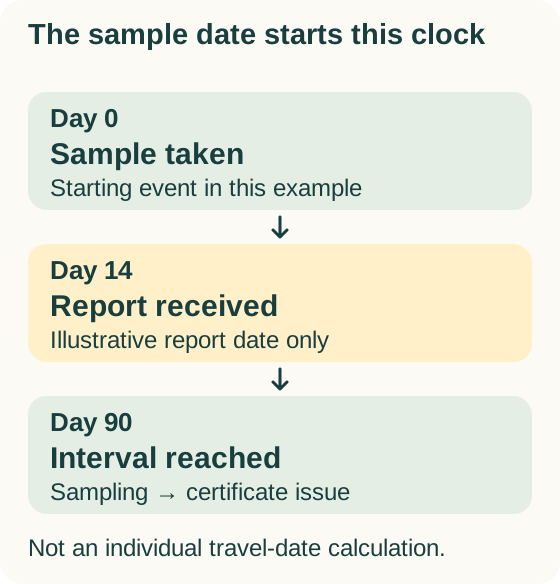
For the example below, assume the reviewed 90-day interval between sampling and certificate issue applies. The sample is taken on Day 0, and the report arrives on Day 14. Counting from the report would move the 90-day point to Day 104 instead of Day 90. The sample date and report date answer different questions; keep both in the record. Day 14 is invented for this example, not an expected laboratory turnaround.
The example illustrates the clock, not an animal’s earliest travel date. Before using a date, the vet and authority still need to establish that this branch applies, the vaccination-to-sampling sequence is valid, the report satisfies the applicable conditions and the correct document event has been identified.
When writing to the issuer, send the dates as separate fields rather than “the test was done in July”. Ask: “Which recorded event starts this interval, which event must wait, and does the return exception change the procedure for this history?” This produces a more useful answer than asking whether a result is simply “still valid”.
Bring the whole record, not just a number
Give the vet the original laboratory report and the vaccination history, including any changes of practice or previous passports. Ask whether the animal identifier is consistent and how the report must be recorded or attached to the travel document.
If a result is below the required threshold, missing or difficult to interpret, the veterinarian should explain the next clinical step and the authority should confirm the travel consequence. Do not infer a retest schedule from an online article.
Plan a return before leaving
Some return provisions depend on preparation and documentation completed before the animal leaves its home regulatory area. A test arranged only after arrival abroad may not put you in the same position. Discuss the whole round trip while the original records and issuing vet are readily available.
Keep the vaccination schedule and return date in the same planning record. A satisfactory historical result is not proof that every later condition has remained satisfied.
Common questions
Is a titre test the same as a rabies vaccination?
No. They are different steps. When both are relevant, the sequence and records matter.
Must a satisfactory test always be repeated for another trip?
Not necessarily. Reuse can depend on the applicable rules and uninterrupted vaccination validity. Have the history checked rather than ordering or dismissing a repeat test automatically.
Can this website calculate my earliest travel date?
No. The planner does not examine vaccination records, classify all origin histories or interpret laboratory results. Use it to record open checks, then confirm the earliest eligible dates with the relevant authority and veterinarian.