
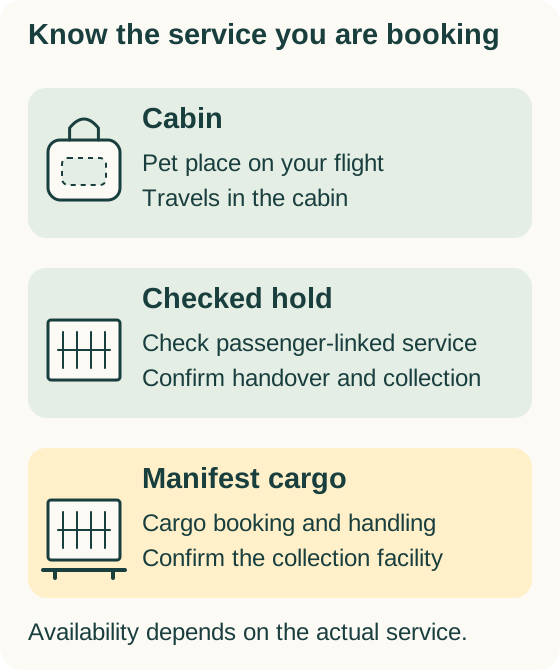
Cabin, checked hold or cargo: which service are you booking?
These terms describe different booking and handling arrangements. Start by establishing which service accepts your animal on the actual route, how it is booked and where handover and collection take place. Weight alone cannot answer those questions.
Discuss health, breathing concerns, stress, medication or sedation with your veterinarian before committing to the journey. This guide explains transport arrangements; it does not rank them by medical safety or decide fitness to fly.
Cabin, checked hold and manifest cargo compared
| Arrangement | What to establish | Where confusion arises |
|---|---|---|
| Cabin | Pet place on the passenger flight, carrier limits, usable space and onboard conditions | A bag fits the published measurements but the animal cannot use it comfortably |
| Checked hold | Whether the operator accepts the animal with the passenger booking, crate requirements and handover/collection | The airline’s checked-pet service is mistaken for a general cargo service |
| Manifest cargo | The cargo booking, shipper/consignee, documents, handling facility and collection process | The owner goes to the passenger baggage desk for a shipment handled elsewhere |
These are practical distinctions, not a promise that every airline offers all three. Hold and cargo conditions need their own current review.
The operating airline is the relevant starting point
Look for “operated by” on each segment. A ticket sold under one airline’s code can be flown by another. Ask who accepts the pet, who confirms its space and whose container policy applies.
Prepare one message with the flight numbers and dates, species, breed, age, transport mode, combined weight and carrier dimensions. Request confirmation for every segment. Keep the response with the reservation and check that it matches the actual flights.
Check fit in two different ways
First compare the external measurements and combined weight with the operator’s published limits. Then assess usable space and construction with the pet inside. A product label or one successful journey on another airline is not proof of acceptance.
Use the carrier guide for a measurement worksheet and the comparison table for the reviewed cabin limits. Those tools cannot assess comfort, age, health or flight availability.
Map the handovers before choosing a transport mode
Ask where responsibility for the animal changes during the journey. For a cabin booking, clarify check-in, screening and any transfer procedure. For a proposed hold or cargo arrangement, ask the operator or handling agent about the precise drop-off and collection locations, required paperwork and contacts during disruption. These questions do not imply that the modes have identical procedures.
Draw the journey as four handovers: home to departure point, departure acceptance, any connection, and arrival collection. Put a named organisation and a contact method beside each stage. If you cannot yet identify the collection point or who to call when the inbound flight is delayed, that is unfinished planning.
At a connection, ask specifically whether the pet is transferred by the operator or must be collected and rechecked by you. The answer determines the next questions about access, time and any border procedure; the passenger connection alone does not establish them.
This handover map also helps compare quotations. Two offers described as “pet transport” may cover different parts of the journey. Ask what service each price includes instead of comparing totals without the same scope.
Ask three questions about a connection
- Who moves the animal? Establish whether the operator transfers it or you must collect and recheck it.
- Where do you have to go? Identify any terminal or airport change, collection facility and opening hours.
- Which border procedure applies? Give the authority the actual handling arrangement and transit itinerary.
A passenger connection time is not evidence that the animal’s handling is feasible. A short layover does not itself establish an airside exemption. If collection or rechecking remains unresolved, compare a different itinerary before buying the ticket.
Build the travel-day sequence
Write down where to arrive, the operator’s pet check-in or cargo handover deadline, the document check, security arrangements and the arrival collection process. Airport-arrival advice and a completed-check-in deadline are different events.
Ask the airport or airline how screening works for your setup, including whether and where the animal might need to leave its carrier. Do not open it in an unsecured public area simply because a generic article suggests doing so.
After a change, confirm the pet again
If a flight, aircraft or operating carrier changes, check the pet reservation and carrier conditions again. Reassess documents and timed preparations against the revised entry time. Record the person or office that confirmed the change.
Do the same for the return. A round-trip passenger ticket should not be treated as evidence that the animal’s arrangements are complete in both directions.