

A carrier must fit the flight and the animal
Use two separate measurements: external dimensions for the airline’s space limit and usable internal space for your pet. Passing one check does not establish the other. “Airline approved” on a product listing is not a universal certification.
Start with the operating airline and transport mode for every flight. The comparison above is limited to reviewed cabin measurements. A cabin bag and a hold crate are not interchangeable.
How to measure the carrier
- Assemble it as it will travel, with the normal base and lining fitted.
- Measure the external length, width and height in that order. Account for fixed parts that occupy space.
- For a soft bag, measure the shape that actually fits under the seat while preserving usable space. A folded empty bag tells you little about a pet inside it.
- Weigh the animal and carrier together when the policy uses a combined limit. Include the items that stay in the carrier.
- Record the figures with units and compare each dimension separately.
Do not substitute a three-dimension total for individual limits. A carrier can have a small total and still be too tall or too wide.
A worked measurement example
Imagine a pet weighing 6.4 kg, a carrier weighing 1.1 kg and 0.2 kg of lining and other contents. The complete setup weighs 7.7 kg. This is a hypothetical arithmetic example, not a recommended pet size or a prediction of airline acceptance.
Now suppose the carrier measures 42 × 28 × 22 cm. The worked comparison above applies those figures to each reviewed airline record; the combined weight alone cannot answer the question. If a dimension exceeds a limit, ask the airline about an alternative instead of assuming the bag can be compressed safely.
Outside fit and inside space are different checks
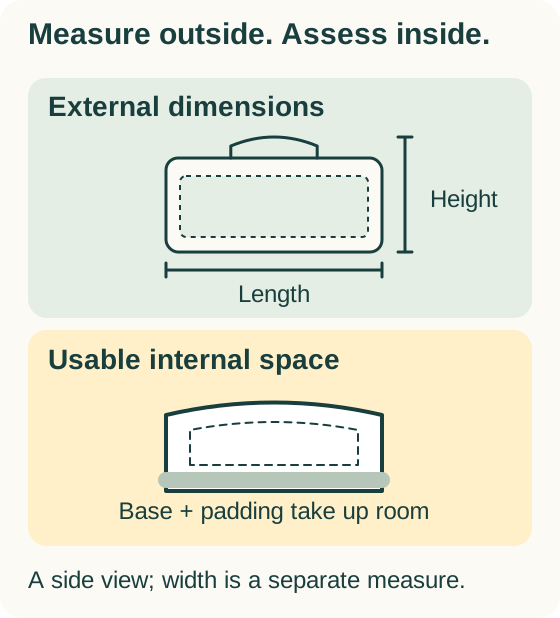
External measurements tell you whether the bag fits the airline’s numerical limits. Internal space tells you what remains for the animal after allowing for the base, padding, frame and sloping roof. Ask the seller for both sets when a listing gives only “size”.
With the carrier safely positioned at home, assess the animal’s natural posture and movement in its travelling configuration. Industry guidance in the requirements panel treats usable space separately from outside dimensions. If fit is unclear or the animal shows distress, seek veterinary or appropriate professional help before committing to the setup.
The drawing below illustrates that distinction. It does not supply a minimum internal measurement or certify a model.
Construction matters too
| Feature | Question to resolve before buying |
|---|---|
| Base and lining | Are they suitable for the airline’s leak-proof and absorbency conditions? |
| Closure | Can the carrier be securely closed against accidental opening or escape? |
| Ventilation | Does the actual travelling configuration preserve the required airflow? |
| Frame, wheels and handles | Are these accepted for the chosen service and stowage position? |
| Access and carrying | Can you carry and handle the complete setup without compromising its closure? |
| Cleaning | Can the carrier be prepared and cleaned as needed between journeys? |
Check these against the operator’s complete policy. The three cabin profiles identify selected construction conditions, while a hold or cargo crate requires a separate assessment.
Decide what to do with the measurement result
| Your finding | Useful next action |
|---|---|
| A dimension or complete weight exceeds a limit | Compare another suitable setup or transport arrangement |
| The numbers fit but the animal’s space is inadequate | Choose a more suitable arrangement; the numerical pass does not settle fit |
| Fit depends on compressing the bag | Describe the actual travelling shape to the operator and resolve usable space |
| Dimensions, space and construction appear suitable | Confirm the pet place and exact carrier conditions for the booked service |
Obtain the seller’s measurements and return conditions before buying. A product review saying “worked on my flight” cannot establish acceptance for your animal and service. Leave time for gradual familiarisation and recheck the complete setup after packing.
Final packing check
Reweigh the complete setup, compare the dimensions with the confirmed flight and check that the animal can use the space. Keep the reservation and required documents accessible. If the airline or aircraft changes, repeat the relevant checks.
There are no affiliate links or product endorsements here. Our comparison helps you ask and measure precisely; the operating airline decides transport acceptance.